

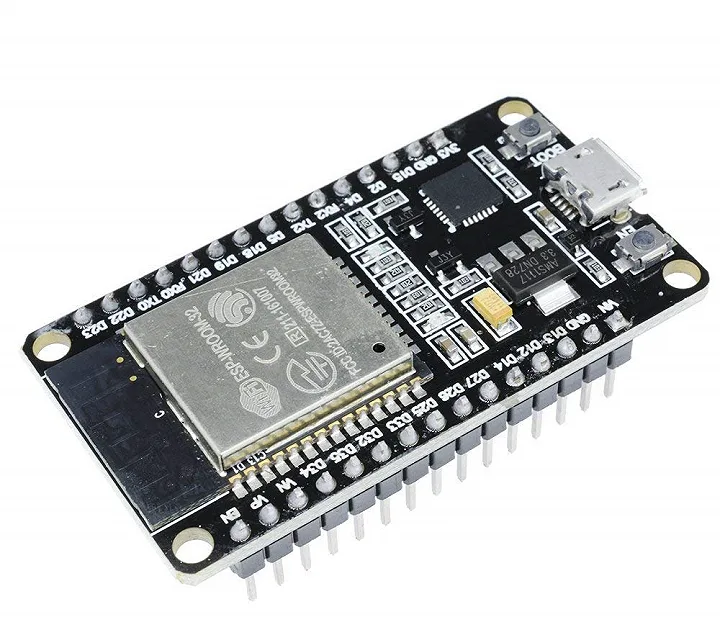
ESP32 is a series of low-cost, low-power system on a chip microcontrollers with integrated Wi-fi and dual-mode Bluetooth .It’s high processing power with in-built Wi-Fi / Bluetooth and Deep Sleep Operating capabilities makes it ideal for most Portable IoT devices. Also now, since Arduino IDE has officially released board managers for ESP32 it has become very easy to program these devices.
The ESP32 is a low-cost, low-power system on a chip (SoC) with integrated WiFi and Bluetooth. It is developed by Espressif Systems and widely used for building IoT devices, wireless sensors, smart home systems, robots, and more.
The development board comes with the ESP32 chip pre-mounted and includes all necessary support components like a USB-to-serial interface, voltage regulators, and GPIO pin headers for easy prototyping.
Key Features
-
Dual-core processor: Great for multitasking applications (e.g., sensors + web server).
-
Integrated WiFi & Bluetooth: No extra modules needed — ideal for wireless projects.
-
Multiple communication protocols: I2C, SPI, UART, PWM, CAN, IR, and more.
-
Analog and Digital IO: Control motors, read sensors, dim LEDs, etc.
-
Low-power modes: Excellent for battery-powered IoT devices.
-
Touch sensing: Useful for custom buttons and interactive interfaces.
-
Supports Arduino, MicroPython, ESP-IDF: Very flexible development.
Common Applications
-
IoT Devices (Home automation, Smart locks)
-
WiFi-based sensors and data loggers
-
Bluetooth-enabled wearables and remotes
-
Robotics and drones
-
Camera streaming or surveillance systems (with ESP32-CAM)
-
Battery-powered smart devices (sleep/wake modes)
Want to Start?
Let me know if you’d like:
-
A simple example code (e.g., blink LED, WiFi connect)
-
How to use it with Arduino IDE or MicroPython
-
A project idea or sensor integration guide
Difference between ESP32 and ESP8266
Both the ESP32 and ESP8266 are Wi-Fi development boards from Espressif systems. They can be programmed using the ESP-IDF or the Arduino IDE. The ESP8266 is inferior in terms of performance compared with the ESP32, but it is cheaper and has smaller form factor then the ESP32. Also the ESP8266 was launched into the market earlier then ESP32 so you will get enough community support for ESP8266.
The main difference would be that ESP8266 does not have an in-built Bluetooth module and also does not feature CAN protocol and has no SRAM. So if you project requires more processing power with Bluetooth or CAN functionalities then you can prefer ESP32 over ESP8266.
if you want to start working on it ,you can watch this video



There are no reviews yet.