

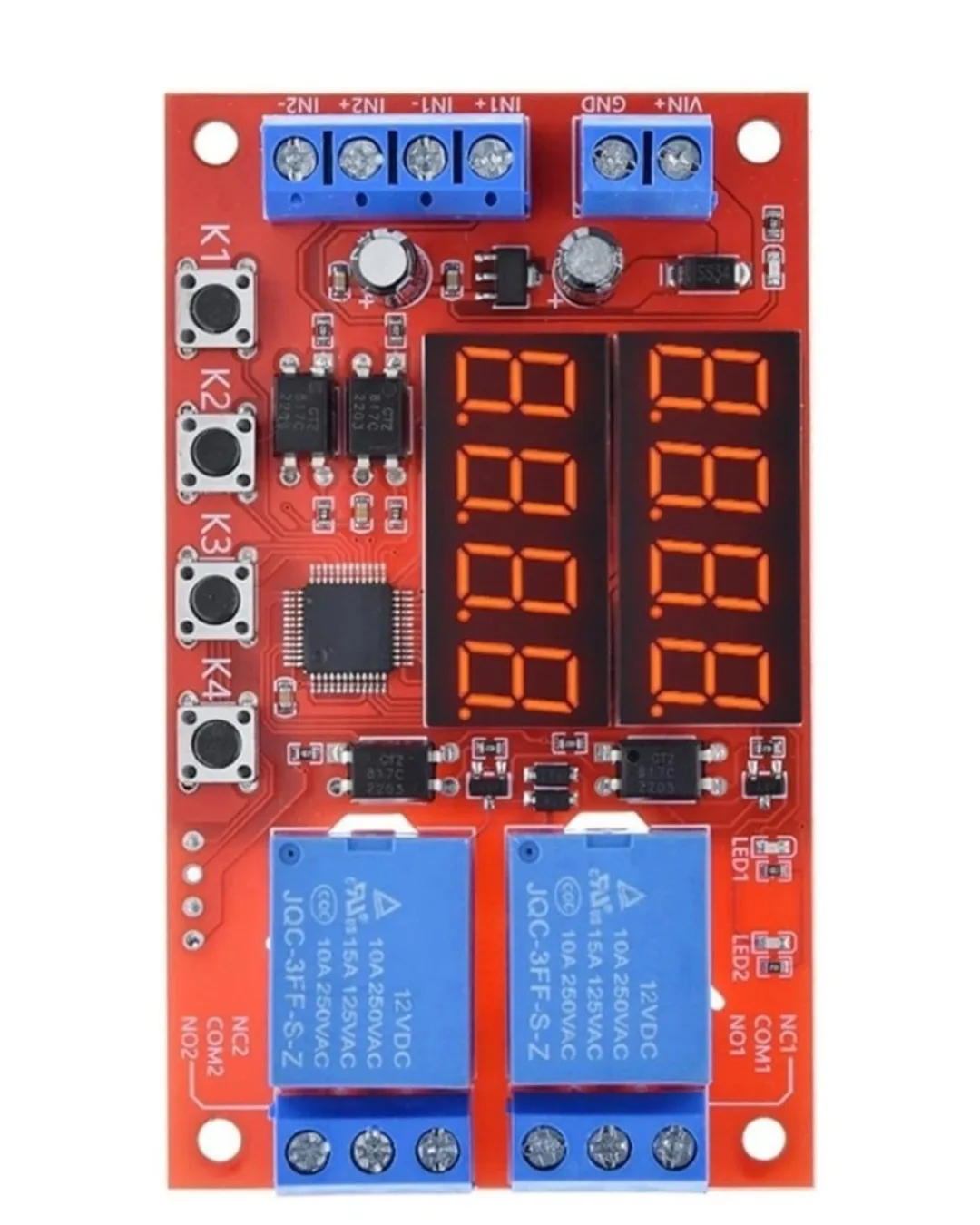
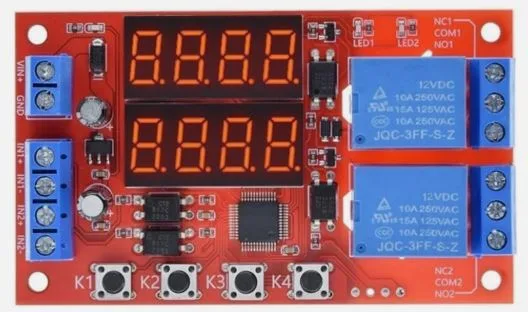
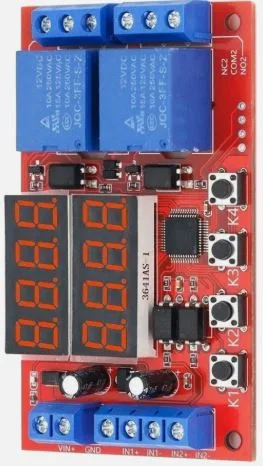
What this module really is
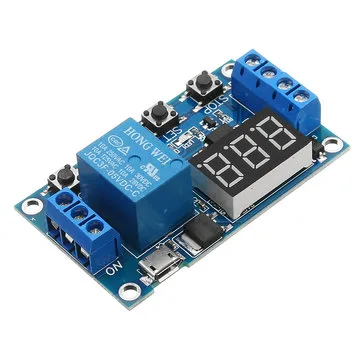
This module is a programmable timer relay that can:
- Control electrical devices automatically
- Use delay, pulse, and cycle timing
- Work without programming
It’s commonly used in DIY electronics and automation systems
Key features (important)
- 32 working modes (P1–P32) → multiple timing behaviors
- Time adjustable → from 0.01 sec to 999 minutes
- 10A relay output → supports motors, lights, pumps
- Dual LED display → shows time & mode
- 4 buttons (K1–K4) → for setting parameters
- DC+ → +12V
- DC– → GND
- IN+ / IN– → start signal
Output (Relay)
- COM → common
- NO → OFF → ON
- NC → ON → OFF
You can set:
- A time → ON time
- B time → OFF time
- C → number of cycles (in some modes)
Example:
- A = 5 sec (ON)
- B = 3 sec (OFF)
- Loop → repeats automatically
Example modes
- Delay ON → turns ON after time
- Delay OFF → turns OFF after time
- Cycle mode → ON/OFF repeatedly
- Self-locking → toggle ON/OFF
Many advanced trigger-based modes also available
Real-life uses
- Water pump control
- Automatic lighting
- Motor timing
- Charging systems
Important safety
- Use correct 12V power supply
- Don’t exceed 10A load
- Be careful with AC mains voltage
Simple explanation
This module is a smart timer switch that controls devices automatically using adjustable time and multiple modes.
- Replace multiple single-function timers with one module – 32 working modes including delay on/off, cycle timing, pulse counting, self-locking, power-on delay, and infinite loops for maximum versatility
- Achieve micro-precision or long-duration control – adjustable timing range from 0.01 seconds to 999 minutes with decimal point placement for seconds, tenths, and minutes
- Handle heavy-duty loads with confidence – 10A relay output with NO, NC, and COM terminals supports motors, pumps, solenoids, lighting, and industrial control circuits up to 12V DC
- Configure in minutes without any coding – intuitive 4-button interface (K1–K4) lets you set working mode, A/B delay times, and cycle counts quickly and easily
- Broad signal compatibility for any system – accepts both positive and negative trigger inputs (IN+ / IN-) and features a bright LED digital display that can be switched off during standby to save energy
- Professional-grade automation at an unbeatable price – get a fully programmable relay timer at just ₹599 (MRP ₹1,800), with free pan-India shipping, same-day dispatch on orders before 2 PM, and COD available
- Shop with complete peace of mind – backed by amiciKart’s 30-day easy no-questions-asked return policy, with secure payment via UPI, Credit/Debit Card, Net Banking, EMI, or Cash on Delivery
Specifications:
Voltage: 12V
Current: 10A
Wiring Port Description:
VIN+: Input DC power positive
GND: Input DC power negative
INl+: The positive pole of the first signal input terminal
INl-: The negative pole of the first signal input terminal
IN2+: The positive pole of the second signal input terminal
IN2-: The negative pole of the second signal input terminal
NC1: Normally closed 1
NC2: Normally closed 2
COM1: Common1
NO1: Normally open1
COM2: Common 2
NO2: Normally open 2
Instructions for use:
Working mode (32 types):
P-12: Self-locking mode, the state of the relay reverses once after each trigger.
P-13: After triggering, the relay will pull in and disconnect after delaying A time; the trigger will be invalid during the delay.
P-14: After triggering, the relay will pull in, and it will be disconnected after the delay of A time; the trigger will be re-timed during the delay.
P-15: After triggering, the relay will pull in, and it will be disconnected after the delay time A; during the delay time, the accumulated timer will be triggered.
P-16: After triggering, the relay will pull in and disconnect after delaying time A; during the delay, a reset will be triggered (relay disconnected).
P-17: After triggering, the relay pulls in for the duration of the signal, the input signal disappears, and then disconnects after the delay of A time; during the delay time, the relay is triggered again to keep the pull in, and the timing stops until the last signal disappears, delay A time Then disconnect.
P-18: The relay will pull in immediately after power-on, and it will be disconnected after a delay of A second; until the next power-on.
P-21: Give the signal, the relay will pull in after the delay of A time.
P-22: Give a continuous signal, after the time exceeds A, the relay will pull in; when the signal disappears, the relay will open.
P-23: When the signal disappears for more than A time, the relay pulls in; when there is a signal, the relay disconnects.
P-24: Give a continuous signal. After the time exceeds A, the relay will pull in; when the signal disappears for more than time A, the relay will open.
P-25: Give a continuous signal, the relay pulls in after exceeding A time; give a continuous signal again, the relay turns off after exceeding A time
P-26: Give a signal, the relay will disconnect after A time pull-in; after the signal disappears, the relay will stop after A second pull-in.
P-27: There is a pulse signal (rising edge or falling edge), the relay is disconnected, there is no pulse signal, the relay pulls in after the delay of A time (continuous high level or continuous low level are considered as no pulse).
P-28: After power on, the relay will pull in after the delay time A until power off.
P-31: After power-on, the relay pulls in time A and turns off time B, in an infinite loop; power off stops.
P-32: There is a continuous signal, the relay pulls in A time, disconnects B time, infinite loop; the signal disappears, and the loop is terminated.
P-33: Give a signal once, the relay pulls in A time, disconnects B time, infinite loop; give another signal to terminate the loop.
P-34: After power-on, the relay pulls in after the delay time A, and disconnects after pulling in the time B.
P-35: Give a signal, after the delay time A, the relay pulls in and pulls off after the time B pulls in.
P-36: Continuous signal is given. After the time A is exceeded, the relay is switched on and disconnected after the time B is switched on; the signal disappears, the timing is cleared, and the relay is turned off.
P-37: There is a signal, the relay will be automatically disconnected after the A time is closed, and the B time will be counted after the disconnection. The signal trigger is invalid during the A+B time.
P-38: There is a signal, the relay will be automatically disconnected after the time of pull-in A, after the time B is counted after the disconnection, it will be automatically disconnected after the time of pull-in A again.
P-41: The signal does not act; the signal disappears and triggers; the relay absorbs and merges after a delay of A time to disconnect.
P-42: The signal disappears. After the delay time A, the relay pulls in; after the delay time B, the relay disconnects.
P-43: The signal disappears. After the disappearance exceeds the time A, the relay pulls in; after delaying the time B, the relay opens.
P-44: After power-on, the relay pulls in time A and turns off time B; after the cycle C times, the relay turns off and stops.
P-45: No action after power on; after the signal is given, the relay pulls in the A time and disconnects the B time; the relay is turned off and stopped after C cycles; when the signal is given, it is executed again.
P-46: After the signal is given more than A times, the relay pulls in; keeps pulling in; the power stops.
P-47: After the signal exceeds A times, the relay pulls in; when it pulls in for B time, it is disconnected.
P-48: During the C time, after continuously giving the signal more than A times, the relay will disconnect and stop after B time.
Description table of the position of the decimal point and the time unit it represents:
x.xx Decimal point is in the hundreds place, time range 0.01~9.99 seconds
xx.x decimal point is in the tenth place, time range 0.1~99.9 seconds
xxx has no decimal point, time range is 1~999 seconds
xxx. The decimal point is in single digits, the time range is 1~999 minutes
Turn off the display: In the non-setting state, press the K4 key to turn off the display, then press it again to turn on.
Description of working parameter setting:
Hold down the K1 key without letting go, after 2 seconds the display shows P-xx, press K2 and K3 to change the working mode. After selecting the working mode, short press K1 to enter the A time setting, the screen displays Axxx, then press K2 and K3 to modify the A time parameters, K2 and K3 key short press plus or minus 1, long press to quickly add and subtract 10, Press the K4 key to set the position of the decimal point. After setting the A time, press the K1 key to set the B time, the screen displays bxxx, then press the K2 and K3 keys to modify the B time parameters, K2 and K3 keys short press plus or minus 1, long press to quickly add and subtract 10, Press the K4 key to set the position of the decimal point.
After setting the B time, (if the mode has the C cycle number parameter), then press the K1 key to set the C cycle number, the screen displays Cxxx, then press the K2 and K3 keys to modify the C cycle number parameter, K2 and K3 keys Short press to increase and decrease by 1, long press to increase and decrease by 10. After setting, press the K1 key once to exit the setting state and save all parameters
Package Includes:
12v 10A Delay Relay Module

 .


There are no reviews yet.