

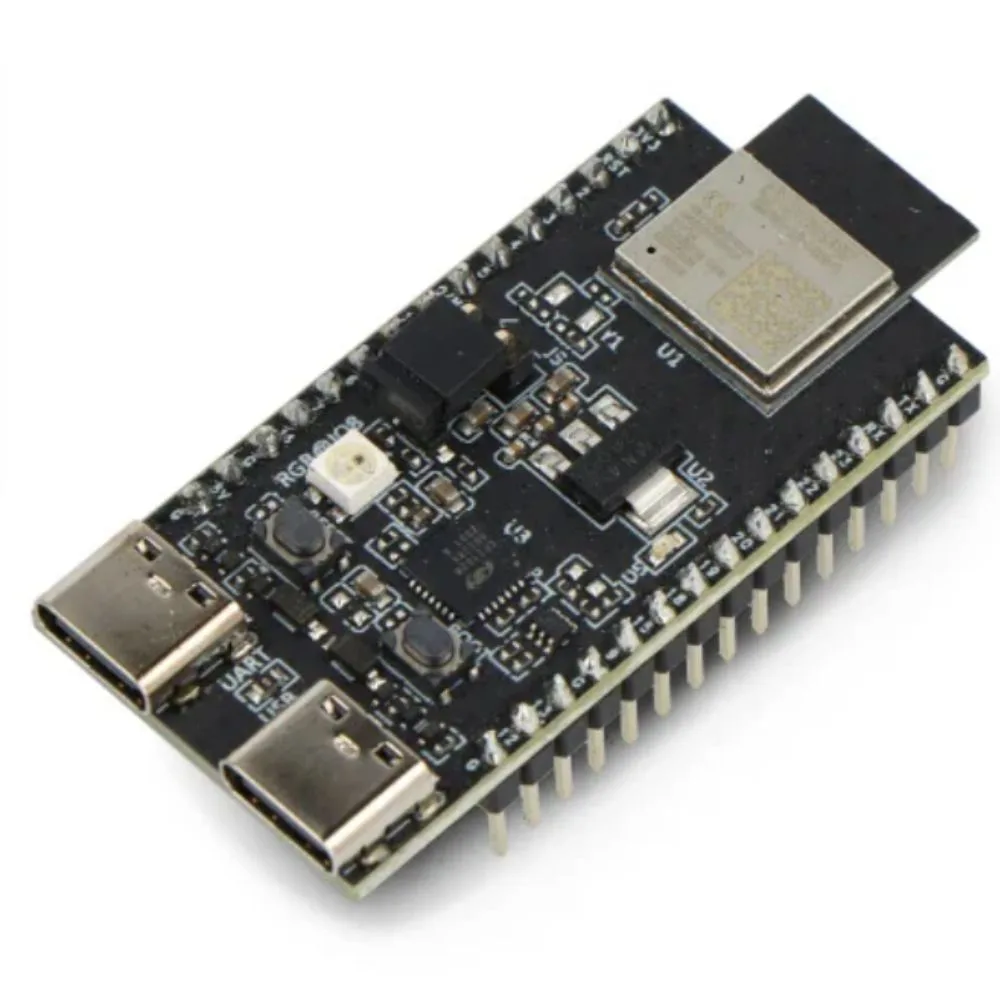
The ESP32-C6-DevKitM-1 is a ready-to-use development board from Espressif Systems, built around their ESP32-C6 series of Wi-Fi 6 / Bluetooth / Thread/Zigbee capable chips.
In particular this board uses the ESP32-C6-MINI-1(U) module (or similar) which includes 4 MB SPI flash and supports multiple wireless protocols.
It’s designed for IoT, smart-home, industrial automation and general embedded connectivity applications where modern wireless (WiFi6, Bluetooth LE, Thread, Zigbee) is desirable.
Because it breaks out many of the GPIOs and includes USB-C and headers, it’s also well suited for prototyping and learning.
Key Features
Here are the standout features of the ESP32-C6-DevKitM-1:
-
Single-core RISC-V 32-bit CPU up to ~160 MHz.
-
Wireless support: Wi-Fi 6 (802.11ax, 2.4 GHz band) + Bluetooth 5 / Bluetooth LE + IEEE 802.15.4 (Thread and Zigbee) on the same board.
-
Module includes 4 MB SPI flash memory (on many variants) for firmware, file systems, etc.
-
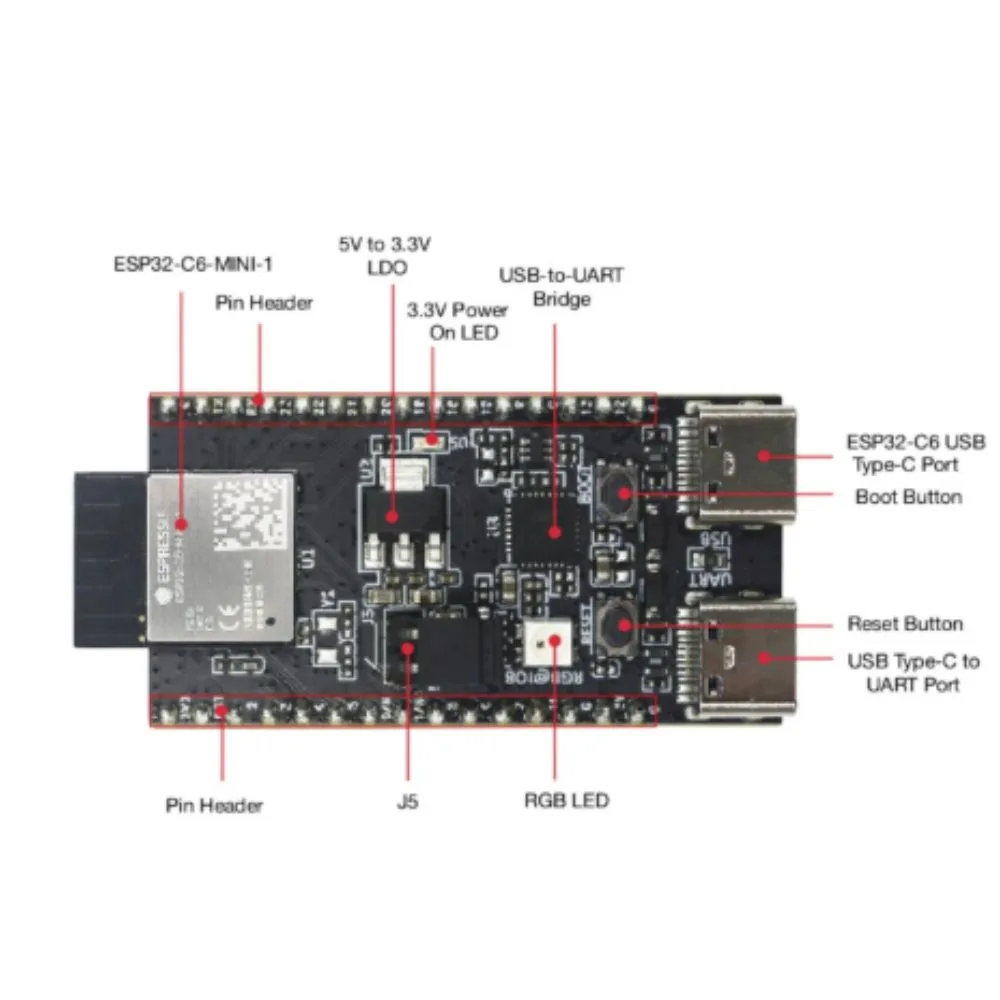
Board includes USB Type-C connector for power/programming, a USB-UART bridge, boot and reset buttons.
-
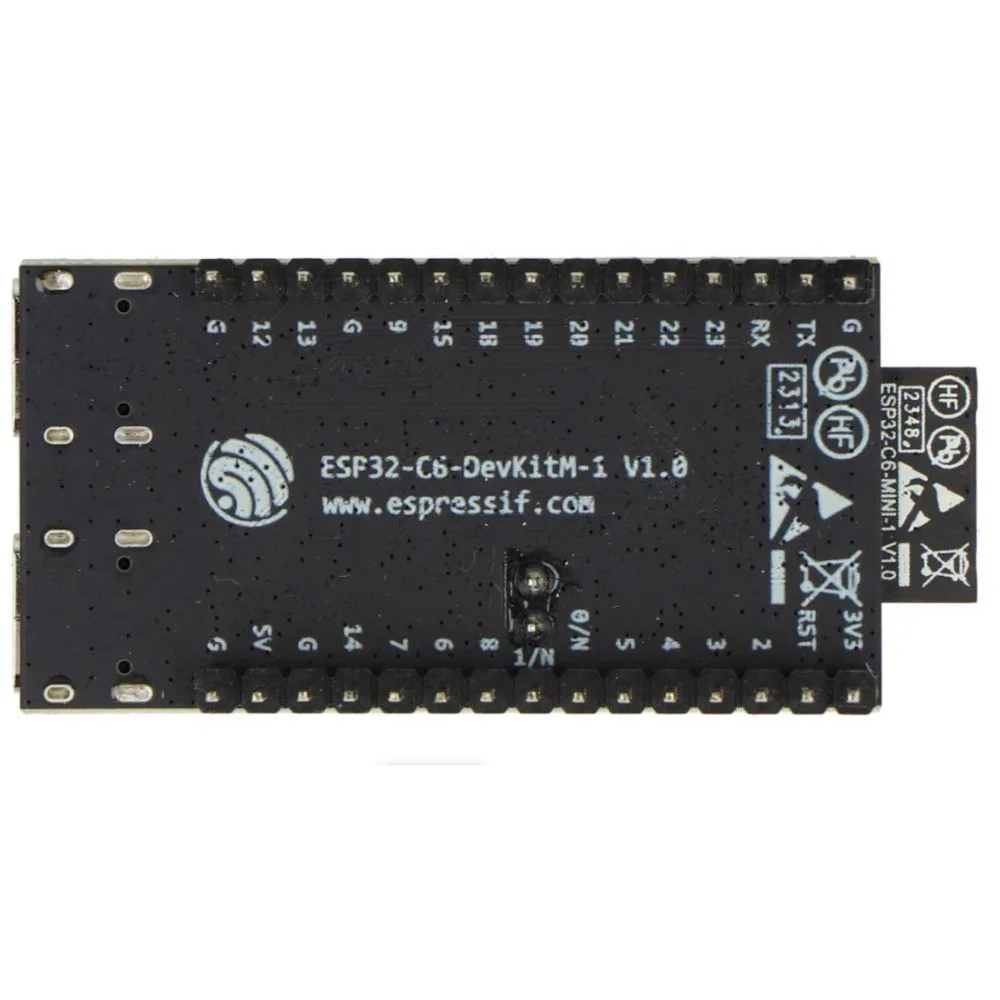
Breadboard-friendly pin headers on both sides for easy wiring, prototyping, and peripheral connection.
-
Onboard LED(s) including addressable RGB LED (on some variants) and power indicator.
-
Power supply flexibility (USB, 5 V, 3.3 V) and current measurement header (on some board revisions) for design tuning.
Specifications
Here is a summary of major specifications (always check the datasheet for your board revision and variant for full details):
| Parameter | Value |
|---|---|
| CPU architecture | RISC-V 32-bit, single core |
| CPU max frequency | ~160 MHz |
| Flash memory | ~4 MB SPI flash (on DevKitM-1 variant) |
| SRAM / memory | Often ~512 kB SRAM (depending on module) |
| Wireless connectivity | Wi-Fi 6 (802.11ax 2.4 GHz), Bluetooth 5 (LE), Thread / Zigbee (IEEE 802.15.4) |
| Board dimensions | ~53.65 × 25.4 mm (for variant) |
| Operating supply voltage | USB Type-C (5 V) or 3.3 V supply header; supports 5 V → 3.3 V LDO onboard. |
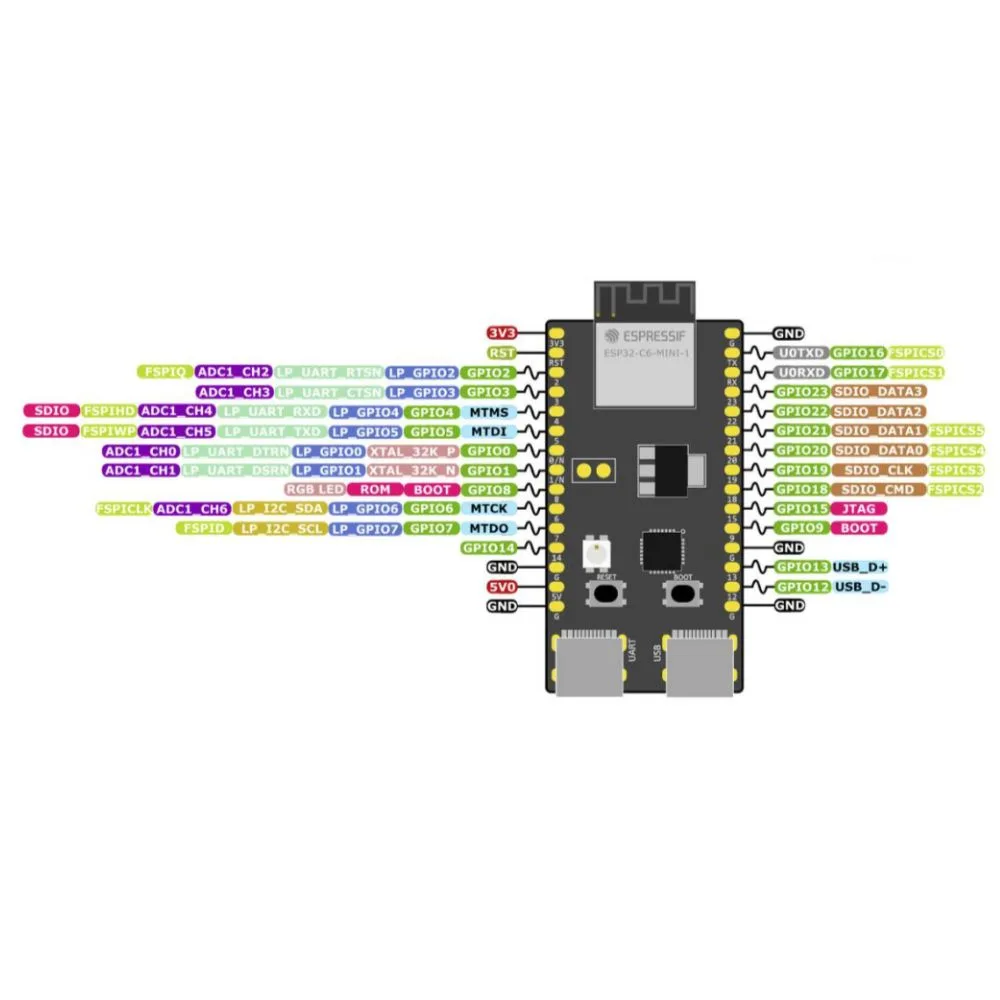
| Number of GPIOs broken out | Many – e.g., ~22 configurable GPIOs on some listings. |
| Operating temperature | One listing: –40 °C to +85 °C (module level) |
| Antenna | PCB antenna (on many variants) |
Practical Tips for Using the Board
Here are some helpful tips when working with the ESP32-C6-DevKitM-1:
-
USB Cable: Use a good quality USB-C cable that supports data (not just charging), for reliable programming and debugging. (The user guide mentions this explicitly)
-
Power Supply: While you can power it via USB, if you connect many peripherals (sensors, displays, etc.), ensure your supply can handle the current. Use the 5 V or 3.3 V headers if needed.
-
Pin Headers / Breadboard Use: With the headers broken out, you can mount the board on a breadboard. Always mind the orientation and pin mapping to avoid mis-wiring.
-
Wireless Protocols: The board supports WiFi6 (2.4 GHz band) and Thread/Zigbee besides Bluetooth. This opens many possibilities — e.g., smart-home mesh devices, sensor nodes, etc. Plan your firmware accordingly.
-
Firmware / SDK: Use Espressif’s ESP-IDF framework (or compatible frameworks) which support the ESP32-C6 series. Ensure you select the correct board variant and version.
-
GPIO & Peripheral Use: Many GPIO pins are available. If you plan to use analog functions (ADC), I/O with interrupts, or communication peripherals (SPI, I2C, UART) check the pinout and any restrictions (some pins may be used for flash, bootstrapping, etc.).
-
Antenna / RF Considerations: The board uses a PCB antenna (on standard variant). If you need external antenna or higher RF performance, verify the module variant (e.g., “U” variant for external antenna connector). Good layout and clearance help for wireless stability.
-
Low-Power / Battery Use: If you are building a battery-powered IoT device, the ESP32-C6 supports low-power modes. Use these along with sensor sleep/wake strategies to maximize battery life.
-
Debugging / Boot Modes: Use the Reset and Boot buttons to enter download / programming mode as documented in the user guide.
-
Thermal & Environmental: Although this board is intended for prototyping, if you deploy it in an industrial environment or sealed enclosure, ensure ambient temperature, ventilation, and power-cycling stress are considered (especially if wireless is used heavily).
-
Variant Check: There are variants like ESP32-C6-DevKitM-1-N4 (4 MB flash) or other suffixes. Make sure when purchasing you match the variant you intend and check the exact specs (flash size, module, antenna type). For example the “N4” suffix denotes 4 MB.


There are no reviews yet.