

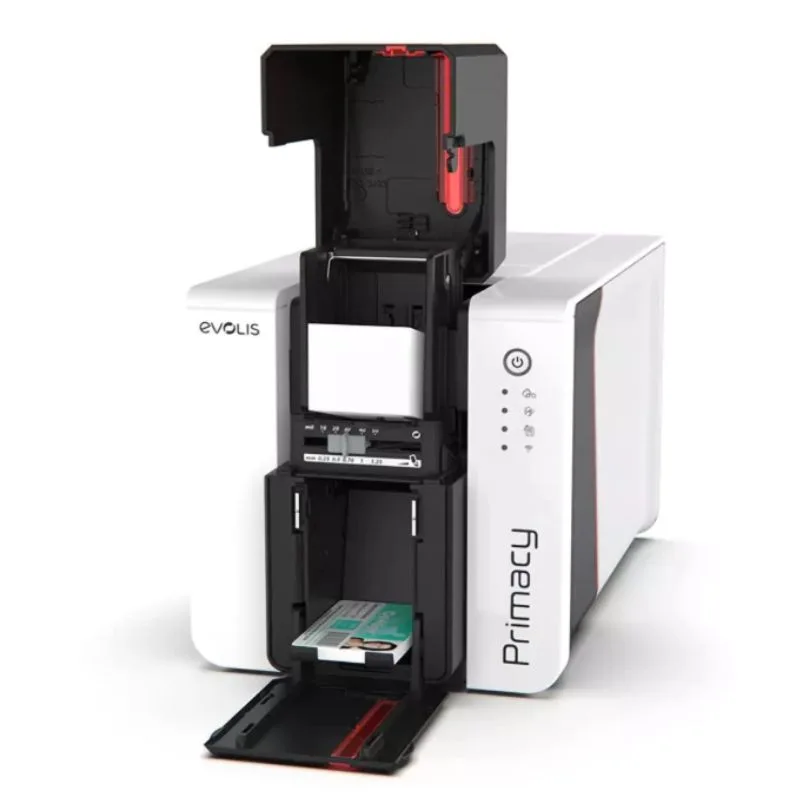

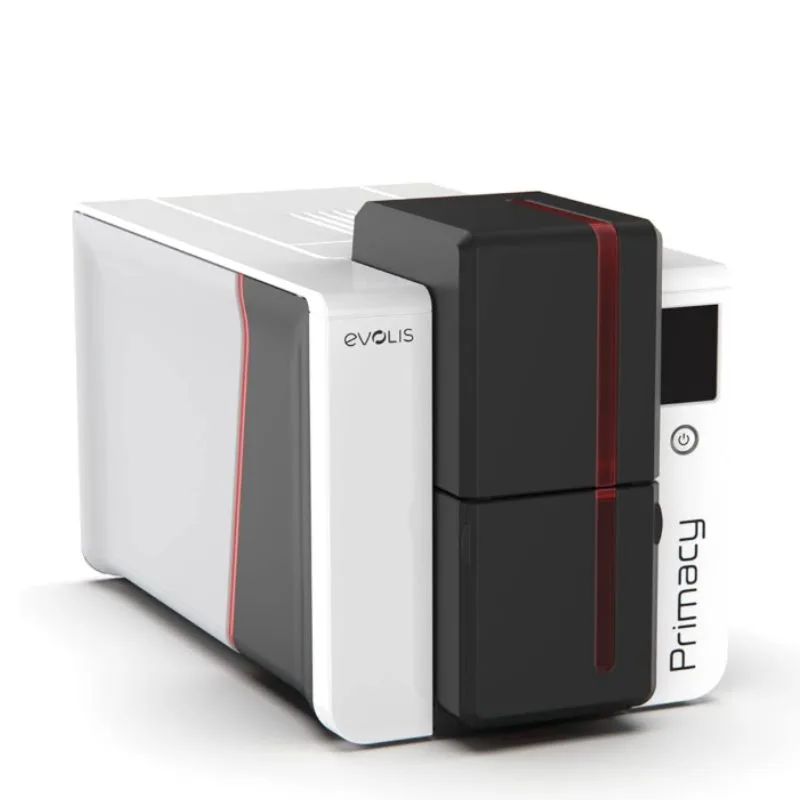

The Evolis Primacy is a professional direct-to-card dye-sublimation & resin thermal-transfer printer designed for single-sided card printing (with upgrade options for dual-sided printing and encoders). It is suitable for medium to large-run card issuance environments — things like ID badges, membership cards, payment/transit cards, student cards and similar plastic cards.
The single-sided version gives you a lower-cost entry point, while retaining high-quality print, edge-to-edge capability, and upgrade potential (encoding modules, dual-side printing later).
Key Features
Here are the major features that stand out:
-
High print quality: 300 dpi resolution (with options up to 300×600 dpi for color/mono and 300×1200 dpi for monochrome) for crisp card graphics.
-
Edge-to-edge printing: you can print the full area of standard cards (ISO CR80 / 85.6 × 54 mm) without unprinted borders.
-
Strong throughput: for example, single-sided color (YMCKO) print speed is around 190–225 cards/hour in many listings; monochrome speeds up to 800–1000 cards/hour in some cases.
-
Front-accessible card feeder and output hopper (~100 cards capacity) for convenient operation.
-
Modular/upgradeable: though this version is single-sided, you can add dual-side printing, magnetic stripe encoder, contact or contactless smart-card encoding modules, lamination modules in some models.
-
Connectivity: USB, Ethernet (TCP/IP) standard; some models offer optional wireless (WiFi) connectivity.
-
Professional software & consumables support: uses Evolis High Trust® ribbons and supports Evolis Premium Suite® software, drivers for Windows/Mac/Linux in many cases.
-
Compact and lightweight: For example, about 247 × 205 × 381 mm footprint and weight around 4 kg for many single-sided versions.
Specifications (Representative for Single-Sided Version)
Below are typical technical specifications — note: check the exact model you purchase for exact numbers.
| Spec | Value |
|---|---|
| Print technology | Dye-sublimation (color) / Resin thermal-transfer (mono) |
| Print resolution | Standard: 300 × 300 dpi; Option: up to 300×600 dpi (color/mono) or 300×1200 dpi (mono only) |
| Max cards/hour (single-side) | Color (YMCKO) ~190-225 cards/hr; Mono up to ~800-1000 cards/hr (depending on mode) |
| Card format | ISO CR80 (53.98 × 85.60 mm) |
| Card thickness | 0.25 to 1.25 mm (10 to 50 mil) typical |
| Input hopper capacity | ~100 cards (0.76 mm card thickness) |
| Output hopper capacity | ~100 cards (or 50 cards in some rear-hopper versions) |
| Interfaces | USB (1/2/3), Ethernet 10/100BaseT, optional WiFi in “Wireless” variants |
| Size / Weight | Example: 247 × 205 × 381 mm; ~4.02 kg |
| Power | 100-240 V AC input in many models; internal 24 V DC printing circuitry |
| Warranty | 3-year warranty (printer & print head) subject to conditions. |
Applications
The Evolis Primacy single-sided printer is well-suited for:
-
Employee ID badge issuance (corporate, educational institutions)
-
Membership / loyalty cards for clubs, fitness centres, etc.
-
Student ID cards, library cards
-
Event badges / temporary visitor cards (especially when only single-sided print is needed)
-
Small-to-medium volume card programs where double-sided printing is not required (or the budget is for single-side only)
-
Environments where upgradeability is valued: you might start with single-sided now and later add encoding or even duplex printing.
Tips for Best Use & Considerations
-
Use genuine Evolis High Trust® ribbons to ensure print head longevity and optimal print quality.Make sure your card stock (thickness, material) is within specification (0.25-1.25 mm). Using too thick cards or out-of-spec materials can cause jams or print issues.
-
Ensure operating environment (temperature/humidity) is within allowed range (typically ~15-30 °C; humidity non-condensing) for reliable performance.
-
Clean print head, card feeder rollers and maintain regularly: in card printers, dust/adhesive can degrade print quality or cause mis-feeds.
-
Use the right drivers/software (Evolis Premium Suite®) for best reliability; driver updates may fix bugs or support OS changes.
-
For single-sided printers: if you anticipate needing printing on the reverse later (e.g., membership cards with back-info), consider whether upgrading to dual-side is cost-effective vs buying duplex now.
-
If encoding (magstripe/contactless) is needed, check whether your model supports adding modules later; check upfront cost/compatibility.
-
Evaluate total cost of ownership: ribbons, cards, print-head wear, maintenance kits should all be factored into long-term cost.
-
For networked usage (shared printer among multiple stations), use the Ethernet interface, and consider where physical access will be (front card feeder & output tray) for convenience.

There are no reviews yet.