


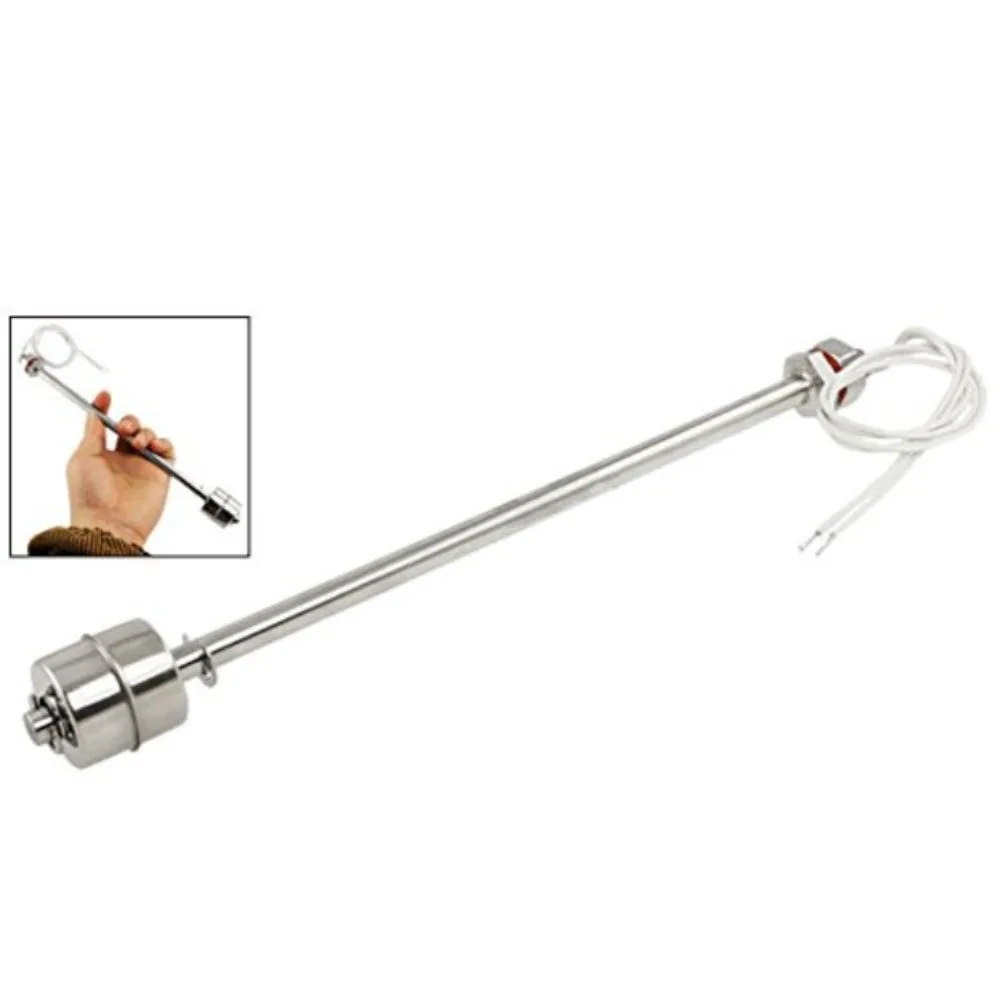
A float switch is a type of liquid level sensor that uses the buoyancy of a float (ball or cylinder) to open or close an electrical contact depending on liquid level. This particular model from uxcell is fabricated in stainless steel, threaded with an M11 mount, and has a 240 mm length (body) for vertical or near-vertical installation. It is used to detect rising or falling water (or other compatible liquids) in tanks, pools, ponds, sumps, etc., and to control pumps, alarms, valves (through relays), or indicators.
Because of its stainless construction, it’s more resistant to corrosion or long-term immersion than plastic-only float switches, making it more suitable for demanding or outdoor applications.
Features
Based on manufacturer descriptions and listings, here are the notable features of this float switch:
| Feature | Details |
|---|---|
| Material | Stainless steel body / float (for durability, corrosion resistance) |
| Thread / mount | M11 (metric thread) for mounting in a tank wall or boss |
| Length | 240 mm (approximately) for the float / stem section |
| Float / ball size | Approx. 26 × 26 mm (or 26 × 27 mm) spherical float (ball) is cited in listing specs |
| Wire length | ~ 350 mm lead wires are typically provided |
| Maximum switching voltage | DC 100 V (in many applications) |
| Maximum switching power / current | ~ 10 W (often ~ 0.5 A at low voltages) |
| Mounting orientation | Can be installed from top or bottom (depending on whether detecting rising or falling level) |
| Switch type | Simple mechanical float actuation: the float slides and actuates a contact inside |
| Conversion between NO / NC | Many float switches of this style can be inverted (or repositioned) to function in normally open or normally closed mode depending on desired behavior (i.e. whether contact closes on rising or completes break on rising) |
| Applications | Used in tanks, water pump control, pool / pond level control, fountains, irrigation, aquariums, water alarms, etc. |
Because this is a relatively simple float switch, the ratings (voltage, current) are modest; it is typically used to signal or drive low-current control circuits (e.g. microcontroller input or small relay), rather than directly switching large pumps.
Typical Specifications
Here’s a more consolidated specification summary (based on product listings). Use this as a reference — actual unit tolerances may vary:
| Parameter | Value / Range |
|---|---|
| Float switch model | uxcell stainless steel float switch, M11, 240 mm |
| Float / body length | ~ 240 mm |
| Float (ball) dimensions | ~ 26 × 26 mm |
| Lead wire length | ~ 350 mm |
| Mounting thread | M11 |
| Maximum switching voltage | ~ DC 100 V |
| Maximum switching power | ~ 10 W (approx) |
| Maximum switching current | Typically ~ 0.5 A (depending on voltage) |
| Contact type | Single contact (mechanical float) |
| Operating mode | Normally Open (NO) or Normally Closed (NC) depending on orientation / wiring |
| Environment | Liquid immersion (water, compatible liquids) |
| Material | Stainless steel (body, float) |
From one listing:
“Max Switching Voltage : DC100V; Max Switching Power : 10W; Float Ball Size : 26x26mm; Wire Length : 350mm; Screw : M11”
Also, other listings are consistent with switching ratings of ~ 0.5 A, 100 V DC, ~10 W power.
Tips / Best Practices & Caveats
When installing or using this kind of float switch, here are important tips and cautions to ensure reliable operation and longevity:
-
Use a relay or driver circuit for higher loads
This switch is not intended to drive high-current loads directly. Its switching current is modest (e.g. 0.5 A or so). If you want to control a pump, solenoid, or motor, use the float switch to drive a relay, transistor, or solid-state switch.
Many listings warn: “Float switch can not directly control solenoid valve or high power relay, AC contactor, etc. Small relays are required for switching.” -
Choose mounting orientation carefully
If you want to detect rising water (pump off when full), or falling water (pump on when low), install the float appropriately (top or bottom). Some float switches can be inverted or flipped to change normally open / normally closed behavior. -
Ensure float can move freely without obstruction
Inside the tank or enclosure, avoid obstructions or turbulence that may jam the float. The float should be able to slide up and down freely. -
Seal / isolate the mounting thread
Use good sealing (e.g. PTFE tape, O-rings, gasket) when screwing into a tank to avoid leaks. Ensure the M11 mount is compatible with your tank boss. -
Avoid overvoltage / overcurrent
Don’t exceed its rated switching parameters (voltage, current). If your control circuit uses higher voltage (e.g. 230 V AC), the float switch should not directly switch it; use it to control a lower-voltage coil in a relay or use an optocoupler, etc. -
Corrosion / environment compatibility
Even though stainless steel is corrosion resistant, in aggressive or saline environments (salt water, alkaline, acidic) corrosion may still occur. Choose proper grade stainless or protective coatings if needed. -
Cable / wire strain relief
Use proper strain relief or cable gland to avoid fatigue or tugging on the wires, especially where they exit the body. -
Test before permanent installation
Test the switch in water (or the intended liquid) to ensure it behaves as expected (i.e. opens/closes at correct levels) before final sealing or fixing. -
Maintenance & cleaning
Over time, scale, sediment, algae or debris may stick on the float or stem and impair motion. Periodically inspect and clean to ensure smooth operation. -
Check compatibility with liquid
Ensure that the liquid you are measuring is chemically compatible with stainless steel (or with the float’s materials). For aggressive chemicals, choose floats and materials accordingly. -
Consider hysteresis / switching deadband
There’s often a small hysteresis (the difference between “turn-on” and “turn-off” levels) inherent in float switches. In some systems, you might want to buffer or time the switching to avoid rapid cycling. -
Protect against sediment or clogging
In tanks with sediment or particles, ensure the float path is kept clear, and consider filtering or placing the switch in a clean zone.

There are no reviews yet.