


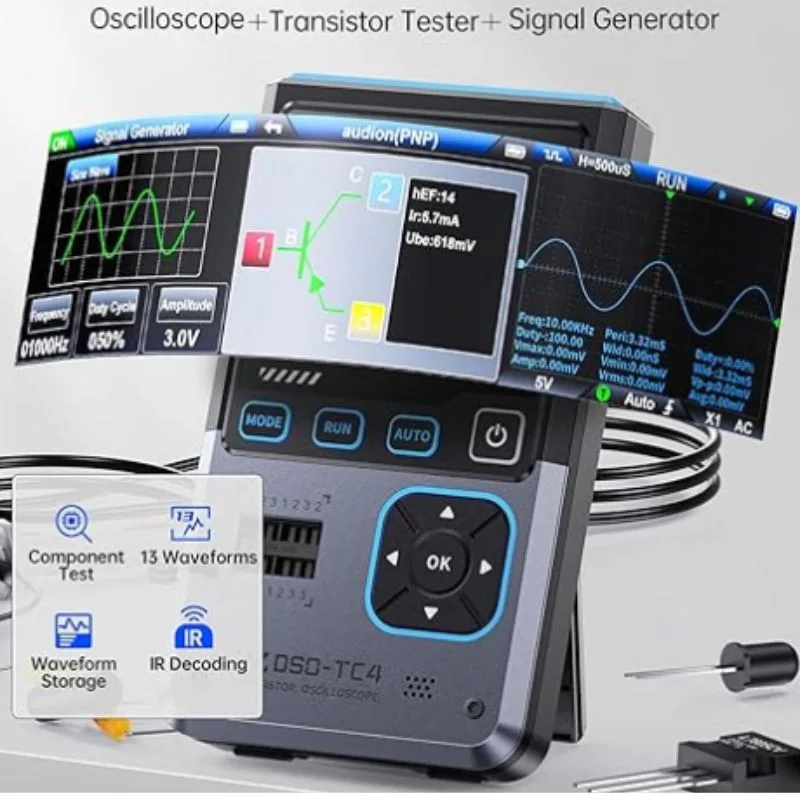
The FNIRSI DSO-TC4 is a handheld, multifunction test instrument that combines a digital oscilloscope, transistor/component tester, and DDS signal generator in a single compact unit. Designed for hobbyists, DIY electronics makers, technicians, and maintenance professionals, it offers essential signal analysis and component diagnostics on the go. With a 10 MHz bandwidth, 48 MSa/s sampling rate, and built-in rechargeable battery, the DSO-TC4 delivers versatile functionality in a portable form factor.
Key Features
Multifunction Integration
-
Combines oscilloscope, transistor & component tester, and signal generator in one device for versatile use.
Oscilloscope Capabilities
-
10 MHz analog bandwidth with 48 MSa/s real-time sampling for basic waveform viewing and signal analysis.
-
Waveform storage/screenshot support makes it easy to save data for later review.
Component & Transistor Testing
-
Automatically identifies and measures semiconductor components such as transistors (including FET/IGBT), diodes, Zener diodes, SCRs/triacs, and passive parts like resistors, capacitors, and inductors.
Signal Generator
-
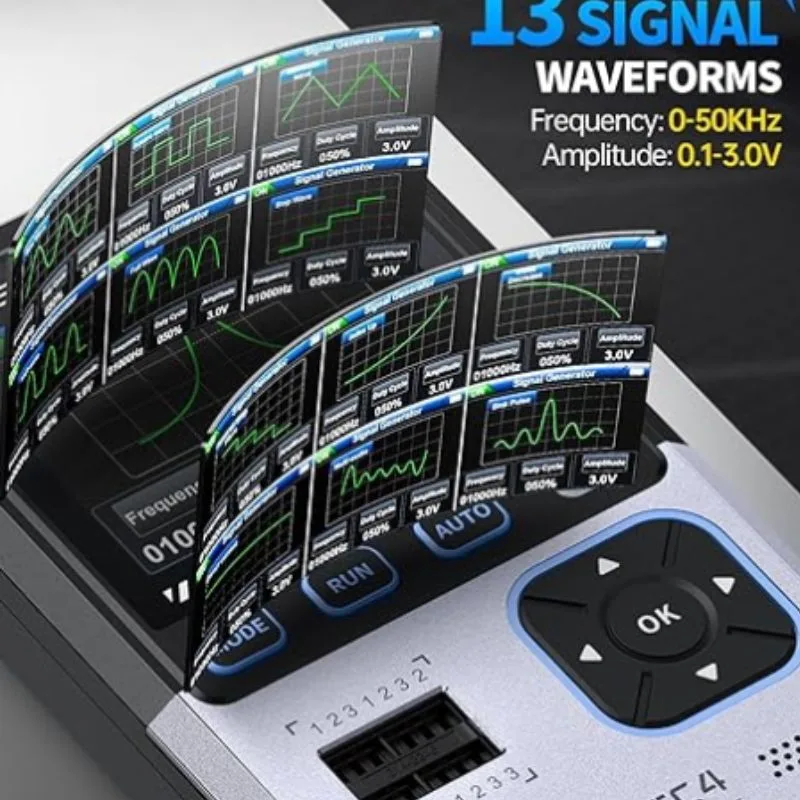
Built-in generator supports 13 waveform types, with frequency up to 50 kHz, adjustable amplitude (≈ 0.1 V – 3.0 V), and duty cycle control.
Portable & User-Friendly
-
Bright 2.8-inch TFT color display with adjustable backlight for clear waveform and data visualization.
-
Rechargeable 1500 mAh battery provides several hours of untethered use.
-
Multilingual interface supports many languages for global users.
Wide Voltage Protection
-
Supports high test voltage ranges using supplied probes: up to ±400 V with a 10:1 probe.
Specifications
General Parameters
-
Model: FNIRSI DSO-TC4
-
Display: 2.8″ TFT Color Screen (adjustable brightness)
-
Power: USB-C 5 V/1 A; built-in 3.7 V, 1500 mAh battery
-
Size: ≈ 90 × 142 × 27.5 mm
-
Weight: ≈ 186 g
-
Languages: Multiple (English, Chinese, German, Spanish, etc.)
Oscilloscope
-
Sampling Rate: 48 MSa/s
-
Bandwidth: 10 MHz
-
Input Impedance: 1 MΩ, AC/DC coupling
-
Voltage Range: 80 Vpp (1:1), 800 Vpp (10:1)
-
Vertical Sensitivity: 10 mV/div – 10 V/div
-
Time Base: 50 ns – 20 s
-
Trigger & Measurement: Auto/Normal/Single triggers; Max, Min, Avg, RMS, Frequency, Duty, etc.
Component Tester
-
Transistors: hFE, Ube, Ic/Ie, leakage currents
-
Diodes/Zeners: Forward drop, breakdown voltage up to ~32 V
-
Resistors & Inductors: Within broad practical ranges
-
Capacitors: 25 pF – 1000 µF
-
Sensor support: DS18B20 and DHT11 (temperature/humidity sensors)
Signal Generator
-
Waveforms: 13 types
-
Frequency Range: 0 – 50 kHz
-
Amplitude: ~0.1 V – 3.0 V
-
Duty Cycle: Adjustable 0 – 100%
Tips for Use
Start with Auto Mode: Use the automatic measurement and auto trigger functions to quickly view signal characteristics without manual setup.
Proper Probe Handling: Always check that probes are securely connected and set to the correct attenuation (1:1 vs. 10:1) for safe and accurate readings.
Battery Awareness: Monitor battery level during portable use — the device can run several hours, but long waveform captures or signal generation can reduce run time.
Use the Hold Feature: When capturing transient signals, use the waveform freeze (HOLD) to examine details.
Component Test Zones: When testing diodes and transistors, ensure the component leads are clean and correctly oriented for best detection and accuracy.
Maintenance
Keep Probes Clean: Wipe down probe tips and connectors regularly to maintain good electrical contact.
Store Safely: Store the device in a dry, dust-free case when not in use — moisture and rough handling can affect performance.
Avoid Overvoltage: Do not exceed rated voltage ranges on any input to avoid damaging internal circuits.
Recharge Properly: Recharge via USB-C when the battery indicator drops low — avoid frequent deep discharges for longer battery life.
Firmware & Manual: Keep the user manual accessible and check for firmware updates from the manufacturer for improved features or fixes.
Applications
Signal Analysis: Visualize and analyze analog or digital signals from microcontroller outputs, sensors, or audio circuits.
Component Testing: Quickly identify and characterize semiconductors like transistors, FETs, diodes, and SCRs, as well as passive components.
Electronics Development: Useful in prototyping, debugging, and testing circuits during hardware design.
Education: Great for students and hobbyists learning about signal behavior, waveform shapes, and component characteristics.
Field & Mobile Repair: Portable design with battery power makes it suitable for mobile maintenance work or field diagnostics.


There are no reviews yet.