


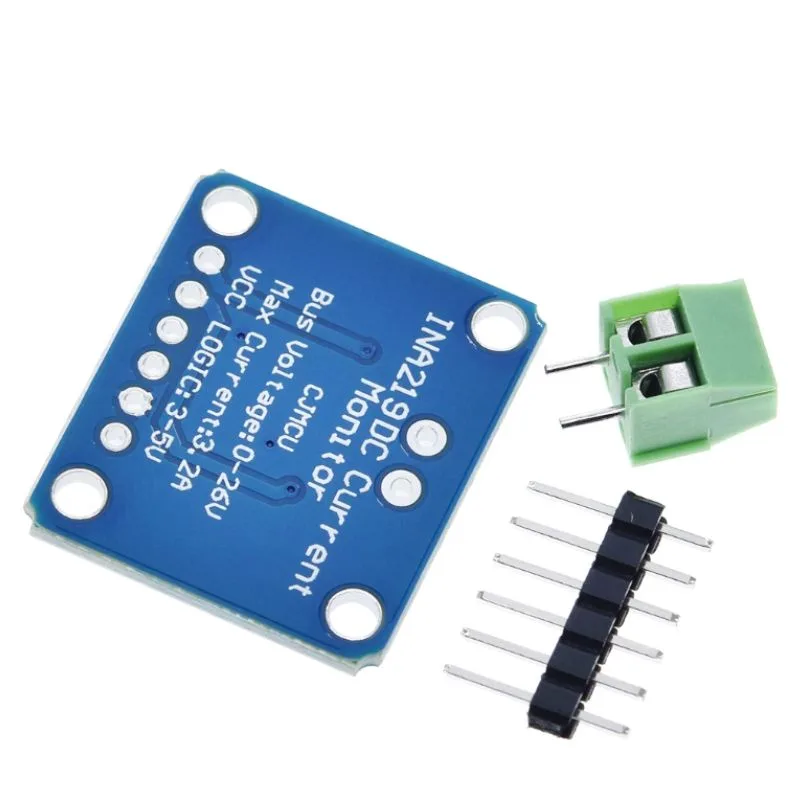
The INA219 I2C Interface High-Side DC Current Sensor Breakout Module is a precise and reliable power monitoring solution designed to measure current, voltage, and power in DC systems. Unlike low-side current sensors, the INA219 measures current on the high side of the power supply, meaning it does not disturb the ground path of the circuit.
This module is widely used in Arduino, Raspberry Pi, ESP32, and other microcontroller projects, offering real-time power monitoring with high accuracy. Thanks to its I2C communication, multiple INA219 sensors can be connected to the same bus, making it ideal for advanced energy-management and battery-monitoring applications.
Key Features
-
High-side current sensing (no ground disturbance)
-
Measures bus voltage, shunt voltage, current, and power
-
I2C digital interface (easy integration with microcontrollers)
-
Programmable gain and resolution
-
Supports multiple devices on one I2C bus (configurable addresses)
-
High measurement accuracy with 12-bit ADC
-
Compact breakout board design for rapid prototyping
-
Low power consumption, suitable for embedded systems
Specifications
| Parameter | Description |
|---|---|
| Sensor IC | INA219 |
| Measurement Type | High-side DC current sensing |
| Bus Voltage Range | 0 – 26 V |
| Shunt Voltage Range | ±320 mV |
| Current Measurement Range | Depends on shunt resistor (commonly up to ±3.2 A) |
| Power Measurement | Calculated internally (V × I) |
| Interface | I2C (up to 400 kHz) |
| ADC Resolution | 9-bit to 12-bit programmable |
| I2C Address | 0x40 – 0x4F (configurable) |
| Operating Voltage | 3.0 V – 5.5 V |
| Shunt Resistor | Typically 0.1 Ω onboard |
| Operating Temperature | –40 °C to +125 °C |
Applications
The INA219 Current Sensor Module is ideal for a wide range of applications, including:
-
Battery monitoring systems (Li-ion, LiPo, lead-acid)
-
Solar power and renewable energy projects
-
Power consumption monitoring in embedded systems
-
Smart energy meters
-
Robotics and motor control current tracking
-
IoT and edge devices energy optimization
-
Overcurrent detection and protection systems
-
Educational electronics and research projects
Maintenance & Handling
-
Ensure correct polarity connection when installing the module
-
Avoid exceeding the maximum current rating of the shunt resistor
-
Keep the board clean and dry to prevent measurement errors
-
Periodically verify readings with a known reference load for calibration accuracy
-
Protect the module from excessive heat and mechanical stress
Practical Tips for Best Performance
-
Calibrate the sensor in software for accurate current and power readings
-
Use short, thick wires for high-current paths to reduce voltage drops
-
Select an appropriate shunt resistor value if higher current accuracy is required
-
Take advantage of programmable gain and resolution for different applications
-
Combine with data logging or display modules for real-time monitoring
-
Use averaging in software to reduce noise in sensitive measurements


There are no reviews yet.