

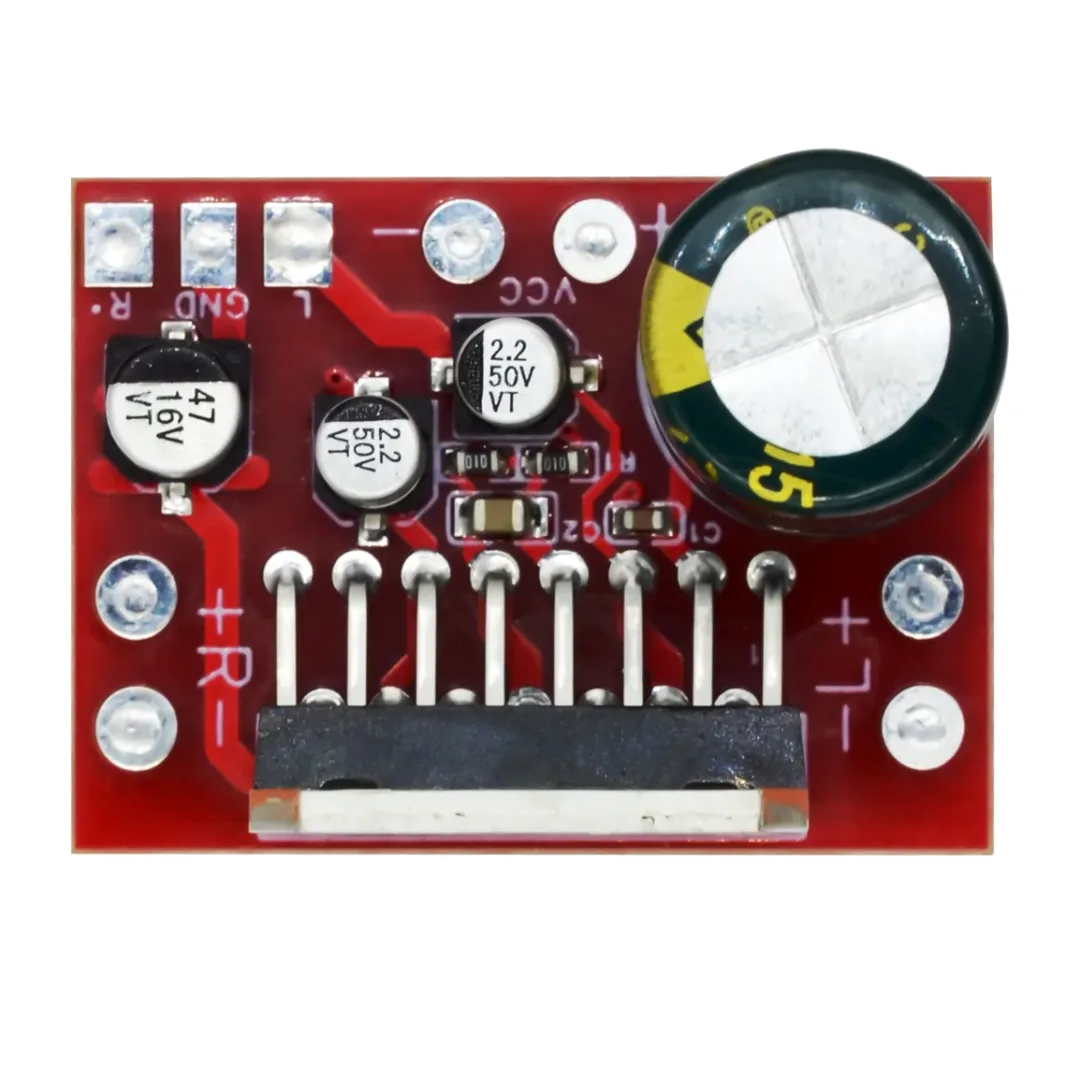
The TDA7379 (originally manufactured by STMicroelectronics) and its clone counterpart, the CD7379, are highly popular Class AB audio power amplifier integrated circuits (ICs) widely used in automotive audio systems, portable speakers, and DIY audio projects.
They are drop-in replacements for each other and share the exact same pinout, power parameters, and structural design.
Core Technical Specifications
The chip is primarily deployed on compact stereo modules utilizing the following default operating conditions:
-
- Output Power: Up to 38W + 38W RMS in Dual Bridge-Tied Load (BTL) configuration at a 4Ω load.
- Supply Voltage: Operates across a broad DC 9V to 17.5V range, making it highly compatible with 12V vehicle batteries and standard power adapters.
- Total Harmonic Distortion (THD): Less than 0.1% at 1 kHz (at 14W output), delivering flat and reliable high-fidelity sound.
- Fixed Gain: Internally fixed at 26dB in BTL bridge mode and 20dB in single-ended mode, reducing the footprint for external components.
- Built-In Protection: Features over-temperature, short-circuit, and undervoltage safety mechanisms.
Key Usage Requirements
- Heatsink is mandatory: Because the TDA7379/CD7379 operates on a Class AB architecture, it generates significant heat under load. Testing or operating the board without a properly mounted aluminum heatsink and thermal paste will cause instant thermal shutdown or permanent silicon damage.
- No insulation needed: You do not need an insulating mica sheet between the metal tab of the IC and your heatsink.
- Current requirement: While it can run at lower capacities, a power supply capable of delivering 10A to 15A is highly recommended to achieve the full 38W stereo output without clipping.

Typical connections
- VCC (+12 V): Power input
- GND: Ground
- L IN / R IN: Left and right audio inputs
- Speaker outputs: Left, Right (and Subwoofer on 2.1 boards)

There are no reviews yet.