


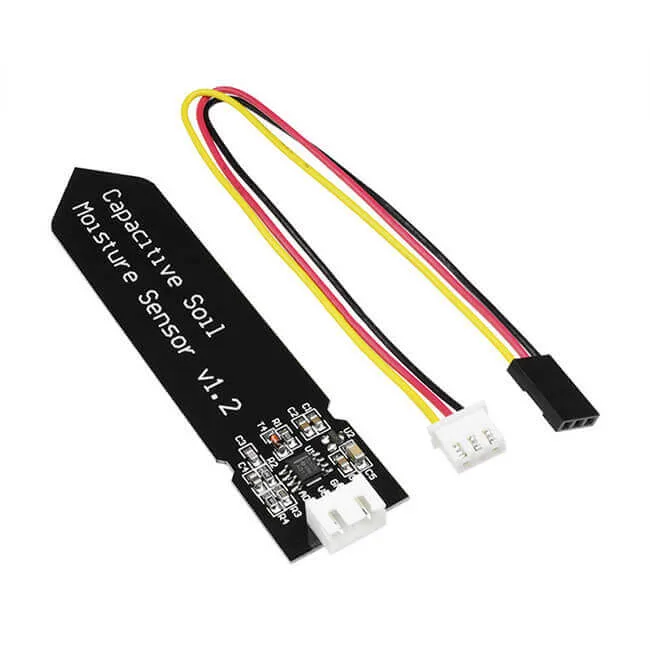
Capacitive Soil Moisture Sensor Module determines the amount of soil moisture by measuring changes in capacitance to determine the water content of soil.
The Capacitive Soil Moisture Sensor is a more durable and accurate alternative to traditional resistive sensors. It measures the dielectric permittivity of the soil, which changes with moisture levels. Unlike resistive sensors, it won’t corrode over time, making it ideal for long-term soil monitoring.
Working Principle
Instead of using exposed metal probes that measure conductivity, the capacitive sensor uses an internal PCB trace to form a capacitor. As the soil moisture around the sensor increases, the capacitance changes, which alters the voltage output. This makes the readings more stable, accurate, and corrosion-resistant.
Features
-
Capacitive sensing – No exposed electrodes
-
Analog output – Works with most microcontrollers
-
Wide voltage support – Compatible with 3.3V and 5V boards (e.g., ESP32, Arduino UNO)
-
Waterproof PCB coating
-
Long-lasting and highly reliable
-
Low power consumption
Specifications
| Parameter | Details |
|---|---|
| Operating Voltage | 3.3V – 5.5V DC |
| Output Type | Analog Voltage (0 – ~3V) |
| Interface | 3-pin (VCC, GND, AOUT) |
| Output Range | Lower voltage = Wetter soil |
| Dimensions | Approx. 98mm × 23mm |
| Material | Anti-corrosive PCB |
Arduino Wiring
| Sensor Pin | Arduino Pin |
|---|---|
| VCC | 3.3V or 5V |
| GND | GND |
| AOUT | A0 |
Sample Arduino Code
Tip: Lower values = more moisture, higher values = dry soil
Calibrate your sensor based on the type of soil you’re using.
Applications
-
Smart irrigation systems
-
Home gardening and greenhouse automation
-
Agriculture monitoring
-
Soil research projects
-
IoT-based environmental sensing.
There are no reviews yet.